








 Deep Detox

 Removes dead...


Best Men's Perfumes in India 2026: A Complete Guide to Fragrance Types and Occasions
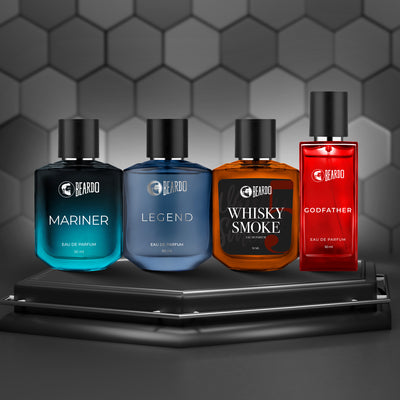
Choosing a men's perfume in India involves variables that Western fragrance guides ignore: extreme heat, high humidity, monsoon conditions, and the cultural weight of scent in South Asian social settings. This guide covers fragrance families, which perform best in Indian conditions, and how to build a 2-bottle wardrobe that covers every situation.
The 5 Fragrance Families Every Indian Man Should Know
Men's fragrances fall into five broad families, each with distinct character and best-use scenarios for India:
| Family | Character | Longevity (EDP) | Best Indian Season | Best For |
|---|---|---|---|---|
| Woody / Smoky | Sandalwood, oud, cedar, smoke | 7–9 hrs | Oct–Feb (winter) | Evening, events, statement days |
| Oriental / Spicy | Amber, vanilla, spices, musk | 7–8 hrs | Oct–Feb | Evenings, date nights, formal events |
| Fresh / Citrus | Bergamot, lemon, mint, green | 3–5 hrs | Mar–Sep (summer/monsoon) | Office, daily casual, outdoor |
| Aquatic / Marine | Sea breeze, damp woods, ozone | 4–6 hrs | Summer/Monsoon | Coastal, outdoor, gym-adjacent |
| Gourmand / Sweet | Coffee, vanilla, chocolate, caramel | 6–7 hrs | Winter only | Casual indoor, evenings |
How Indian Heat Affects Fragrance Performance
Heat amplifies fragrance projection — a moderate EDT that works perfectly at 22°C in a Delhi winter can become overwhelming at 38°C in a Mumbai summer. The fragrance molecules evaporate faster, projecting more intensely but also burning off sooner. In summer: choose lighter EDT concentrations, avoid heavy orientals and musks outdoors, and apply to fewer pulse points (neck only rather than neck + wrists + chest). In winter: EDPs can be worn at full strength across all pulse points.
Building a 2-Bottle Fragrance Wardrobe for Indian Men
Most men need two fragrances: a daily workhorse and a signature for occasions. The daily workhorse should be an EDT in the fresh or aquatic family — light enough for summer, versatile enough for year-round office use. The signature should be a woody or oriental EDP — something with more depth and longevity for evenings, events, or the cooler months. Together, two well-chosen fragrances cover 95% of all social and professional situations.
Fragrance Notes Explained: Top, Heart, and Base
Every fragrance evolves through three stages. Top notes are what you smell in the first 15–30 minutes — bright and volatile (citrus, herbs, light spices). Heart notes emerge as the top notes fade and define the fragrance's main character for hours 1–5 (florals, woods, spices). Base notes are the deep, lasting foundation detectable from hour 3 onwards (oud, amber, musk, vanilla, sandalwood). When testing a fragrance in-store, always wait 20 minutes after application before deciding — you need to smell the heart notes, not just the top.
Fragrance Strength vs Price: The India Value Guide
In India's fragrance market, the ₹1,500–3,000 range offers the best value for homegrown and Indian-market EDPs. At this price point you get 6–8 hour EDP longevity with quality fragrance oils — comparable to global brands in the ₹5,000–8,000 range for equivalent performance on Indian skin. Indian-market fragrances are often specifically calibrated for Indian skin chemistry and climate conditions, giving them a performance advantage over direct imports designed for European conditions.
How to Test a Fragrance Before Buying
Never buy a fragrance without wearing it on your skin for at least 30 minutes. Spray on inner wrist. Let it dry completely. Smell at 5 minutes (top notes), 20 minutes (heart notes), and 40 minutes (base notes beginning). The 40-minute test tells you what you'll actually smell like for most of the day. If you still like it at 40 minutes, buy it. Paper blotters are useful for eliminating candidates, but skin is the only accurate test surface.